Instagram ideal client clarity is one of those phrases that gets thrown around constantly — and most founders believe they have it. They’ve done the worksheets. They’ve filled out the avatar. They know their person is a millennial mom who runs an online business and wants more freedom. And yet their content isn’t converting, their DMs are quiet, and Instagram feels like a lot of effort for very little return.
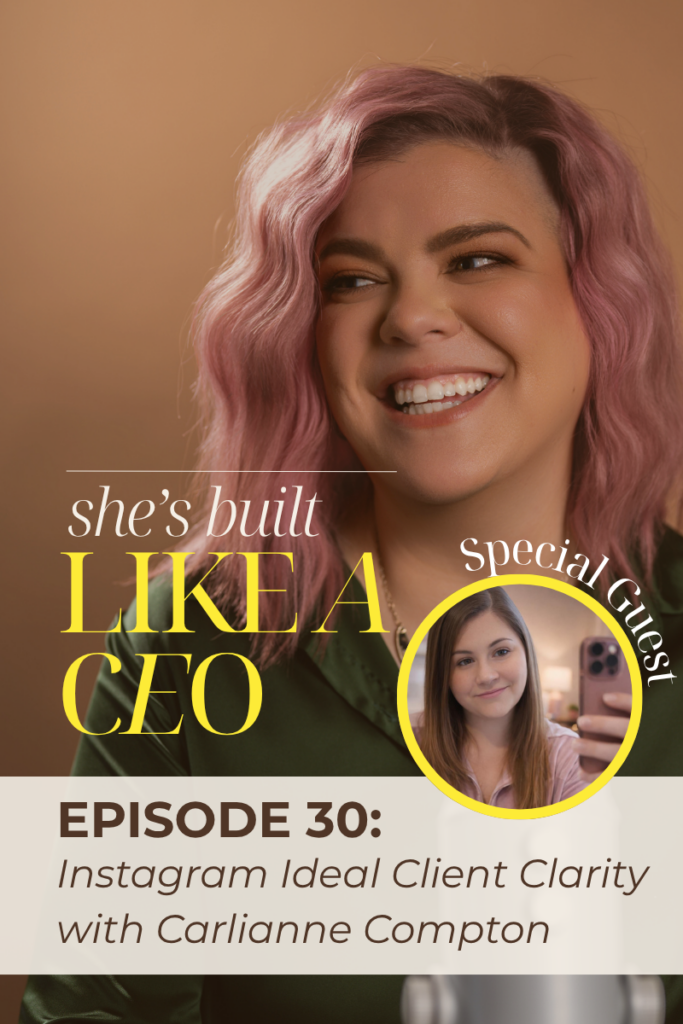
In Episode 30 of She’s Built Like a CEO, Brooke sits down with Carlianne Compton — Instagram strategist and founder of Court Your Client — to get into what ideal client clarity actually means at the level that moves the needle. They cover what kills DM conversations before they start, how to find your people on Instagram without scrolling aimlessly, what to focus on regardless of what the algorithm does next, and why fun content that has nothing to do with your business still belongs in your strategy.
One note from Brooke before you dive in: the backend of your business is only part of the picture. When she sees gaps in areas outside her lane during a backend audit, she wants to make sure you have somewhere to go. Carlianne is one of the experts she trusts in that space.
Listen to Episode 30
🎤 Listen now:
Listen on Spotify → | Apple Podcasts → | All Episodes →
What We Cover in This Episode
- What ideal client clarity actually means — and why most founders only have the surface level
- Why getting more specific doesn’t cancel out potential clients — it attracts the right ones
- What a DM conversation that leads to a client actually looks like (hint: it’s not one conversation)
- The specific DM mistakes that kill relationships before they start
- How to find and source your ideal clients on Instagram without scrolling blindly
- What stays consistent regardless of algorithm changes — and where to focus
- Why fun, relatable content that has nothing to do with your business still belongs in your strategy
- Carlianne’s new IG self-audit quiz and what it helps founders find
Key Takeaways From This Episode
Most founders have a shell of an ideal client — not a person.
A demographic description like “millennial mom healing from burnout” gives you a title, not a person. Carlianne compares it to describing her kindergartner only as “a kindergartner” — technically accurate, but it tells you nothing about how to connect with him. The same applies to your ideal client. Furthermore, the surface-level description is what everyone in your industry is using, which means your content sounds like everyone else’s. Getting to the internal thoughts, specific fears, and recurring patterns your person carries is what makes content stop someone mid-scroll.
Specificity doesn’t shrink your audience — it attracts the right one.
The most common reason founders resist going deep on ideal client clarity is fear of excluding potential clients. However, Carlianne points out that people resonate with patterns and feelings, not just identities. Someone who has never been diagnosed with ADHD can still recognize themselves in ADHD content if the thought patterns match. As a result, the right specificity doesn’t cancel out people — it pulls in more of the right ones and starts doing the work of filtering for you.
DM conversions are built over time, not in a single exchange.
There is no magic DM script that converts a stranger to a client in one conversation. Instead, Carlianne describes it more like meeting other parents at your kid’s baseball game — you start with surface-level conversation, you show up consistently, and over time the connection deepens naturally. Consequently, the founders who see DM conversions are the ones who invest in real relationships with no agenda attached to every single exchange. The conversion follows the trust.
Two things kill DM conversations before they have a chance to start.
First, automated welcome DMs to new followers. Even with a built-in delay, the copy-paste nature comes across as disingenuous and closes the door on a real connection before it opens. Second, what Carlianne calls “scarcity energy” — that frantic impulse to tell someone everything about your business the moment they engage. One message in, and suddenly they’re receiving your full offer suite, your current discount, and three links. It overwhelms people and they leave. Additionally, as Brooke points out, your audience is not looking for someone to spoon-feed them — they know how to find your links. Trust them.
The algorithm is run by people’s decisions — so focus on your person, not the platform.
The algorithm changes constantly, but the principle underneath it doesn’t. It surfaces content based on what people engage with, click on, and search for. Therefore, the most reliable way to work with the algorithm is to understand your ideal client at a psychological level — what makes them stop, what makes them laugh, what makes them feel seen. When your content does that, the algorithm takes care of the distribution. Trying to reverse-engineer the platform is a moving target. Knowing your person is not.
Fun content widens the top of your funnel — and that’s a feature, not a flaw.
For years the advice was to keep business accounts strictly business. That’s changing. Carlianne shares how relatable, fun content that has nothing to do with her services has significantly expanded her reach and brought in followers who later convert to clients. The key is understanding where this content fits in the funnel — it’s top-of-funnel, awareness-level content. Moreover, it’s not supposed to convert immediately. Its job is to bring more of the right people into the ecosystem so they can find their way down.
When ideal client clarity is deep enough, content becomes intuitive.
This is the payoff Carlianne describes for founders who do the deeper work. Instead of sitting down with a blank Google doc and asking ChatGPT what to post, ideas come while walking, doing dishes, or living their life. Specifically, because they understand their person well enough to think like them, the content practically writes itself. That’s not a creative gift — it’s the result of doing the clarity work at a level most founders stop short of.
Find Carlianne Compton

Carlianne Compton is an Instagram strategist who helps service-based businesses grow on Instagram and turn their social media presence into actual revenue. She specializes in ideal client clarity, messaging, and DM conversations — the kind of work that turns followers into paying clients.
- Instagram (IG strategy): @conversionwithcarli
- Instagram (learn to be a SMM): @carlianne_compton
- Website: go.carliannecompton.com/strategy-reset-page
Carlianne is also putting the finishing touches on her IG self-audit quiz — a free resource that helps founders identify exactly which piece of their Instagram strategy needs attention first, before trying to tackle everything at once. Check her Instagram for the launch.
Resources From Brooke
Free Backend Self Audit — If this episode made you think about what’s happening behind the scenes of your business, start here. Walk your own backend through Brooke’s diagnostic process at no cost.
Backend Business Audit — 90 minutes with Brooke to look at your specific backend, identify exactly what needs to change, and walk away with a clear and prioritized roadmap.
Your Instagram Strategy Starts With Knowing Your Person
Instagram ideal client clarity isn’t a one-time exercise. It’s the foundation that every other piece of your Instagram strategy — your content, your DMs, your sourcing, your funnel — gets built on top of. Without it, you’re making content for a room you can’t quite picture. With it, you’re talking directly to one person who feels like you made it just for her.
If this conversation made you think about the gaps in your own business — whether that’s on Instagram or in the backend systems underneath it — both Carlianne and Brooke have a place to start. Links for both are above.




Leave a Reply