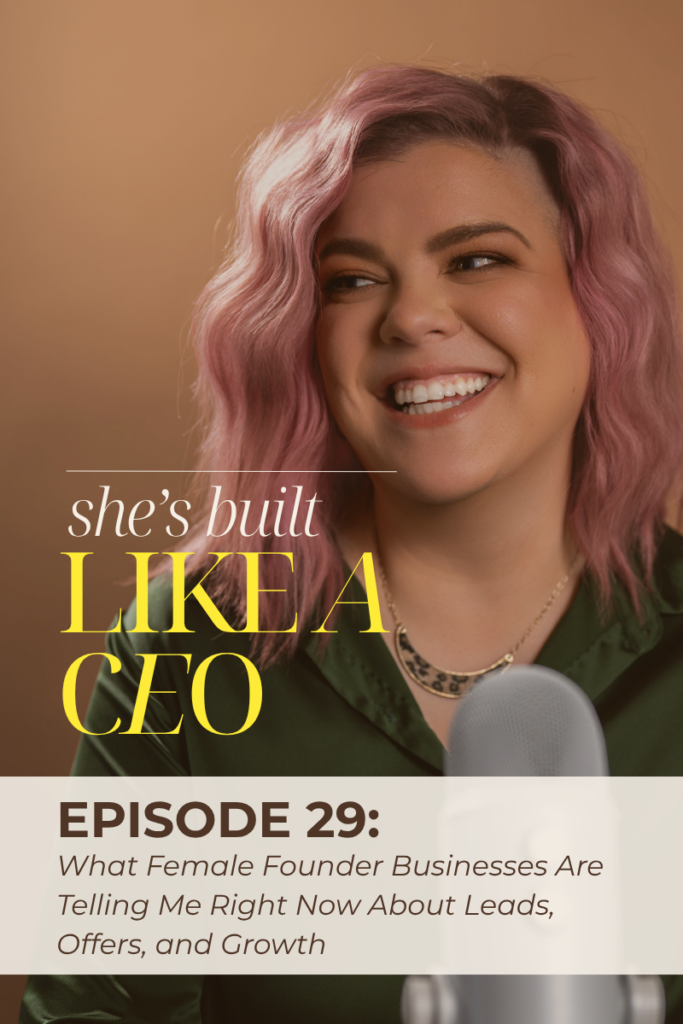
A good female founder business diagnosis starts with one question: are you solving the right problem? In Episode 29 of She’s Built Like a CEO, Brooke shares four conversations she keeps having with founders across different businesses and different stages — and the single thread running underneath all of them.
The market has shifted. People are spending differently, visibility is harder to earn, and sales cycles are running longer. When revenue slows, the instinct is to move fast and fix something. However, the urgency tends to surface the most visible symptom — and the most visible symptom is rarely the root cause. Consequently, a lot of founders are making moves that don’t produce results, not because the moves are wrong, but because they’re solving the wrong problem.
If any of the four conversations below sound familiar, this episode is going to land hard.
Listen to Episode 29
🎙 Listen now:
Listen on Spotify → | Apple Podcasts → | All Episodes →
What We Cover in This Episode
- Why the current market is making founders move fast — and why that’s dangerous
- The four conversations Brooke keeps having with founders right now
- Why diagnosing the wrong problem produces the wrong result every time
- What to look for in your backend before making your next business move
- The one thread running underneath all four conversations
The 4 Conversations — and What’s Really Going On
Four different founders, four different businesses, four different conclusions about what the problem is. Nevertheless, the root cause is the same in every single case.
1. “I need more leads.”
The pipeline feels slow, inquiries are low, and the conclusion is that more leads would turn everything around. That can be true — but before spending on ads or doubling down on content, it’s worth asking a more specific question: are you actually set up to receive the leads you already have?
In most cases, the leads exist. They come in from content, from referrals, from whatever brought them into your ecosystem. However, there’s no nurture sequence moving them forward, no clear path from interested to booked, and no follow-up system catching the people who showed up but didn’t take action yet. As a result, leads arrive, sit, and eventually leave.
Consider this: fifty inquiries with a two percent conversion rate looks like underperforming ads. Moreover, those same fifty inquiries with a proper nurture sequence and a clear call to action could reasonably convert at ten to fifteen percent — five to ten times the return on the same ad spend. The gap is in the infrastructure that receives leads, not in the volume of them.
Before the next ad spend, map out exactly what happens when someone joins your email list. Does a nurture sequence exist? Does it lead somewhere specific? Is there one clear call to action, and does every touch point point to the same place? That’s the audit before the investment.
2. “My offer isn’t right.”
When revenue stalls, the offer becomes the prime suspect. So the offer gets rebuilt, the suite gets reorganized, or everything gets scrapped and started over. Brooke’s observation after looking at the backends of businesses in this situation: 99% of the time, the offer itself is fine.
Instead, the gap is in the buying experience. The offer and the sales page describe it slightly differently. The link in bio requires four more clicks to reach checkout. The call to action isn’t clear enough for someone who is ready to buy right now. A person ready to purchase will not do that extra work — they’ll move on. Therefore, weeks spent rebuilding an offer and relaunching it with the same buying experience behind it will produce the same result.
The diagnostic move here is to walk the purchase path yourself — from the first point of expressed interest all the way through to a completed transaction. Count every step. Look for messaging shifts. Identify every fork where someone could reasonably get confused, give up, or decide it isn’t worth the effort. That’s where the actual work is.
3. “I need to grow — more clients, more revenue streams, more volume.”
This one isn’t necessarily the wrong goal. It’s a sequencing problem. When revenue has plateaued, more volume feels like the solution. But if the current business structure runs on personal effort — manual onboarding, client communication living in your head, deliverables that require you to initiate every step — adding volume doesn’t create growth. It adds pressure to something that has already hit capacity.
More clients means more of everything: more onboarding, more communication, more delivery, more follow-up. Furthermore, if all of that still requires your direct involvement at every step, the client experience becomes inconsistent, retention drops, and the result is more hours for the same revenue or less. The ceiling here is structural, and growth doesn’t move it. Building the infrastructure first does.
The question to ask before adding volume: what would require your direct involvement if your client load doubled tomorrow? Every answer that isn’t already systemized is a gap to close before you scale — because that structure is what makes the growth sustainable once you go after it.
4. “I need more visibility — more content, more collaborations, more presence.”
Sales are slow and the diagnosis is that not enough people can see the business. So the plan becomes more content, more podcast appearances, more showing up everywhere. More presence is not a bad goal — but it’s worth pausing to ask what’s happening with the attention that already exists.
In many cases, the attention is there. Followers exist, the email list has subscribers, people engage with content and click the links. However, the gap is in what happens after the click. The link in bio goes to a page that doesn’t match the content promise. Someone expresses interest in the comments and nothing captures it. People arrive, look around, and leave because there’s no clear next step waiting for them.
Consequently, more visibility sends more people through the same leaking funnel — volume goes up but the conversion rate stays flat. Before expanding the top of the funnel, tighten the path for the audience already there. Specifically, ask whether every place you show up has one clear visible next step, whether there’s a system moving people from follower to subscriber to buyer, and whether that path requires you to do something manually between each step.
The One Thing Running Underneath All Four
Four conversations, four different symptoms. One root cause running underneath all of them: the backend infrastructure hasn’t kept pace with the business. The gaps in it fill up with your time, your energy, and your manual effort — and that’s where the ceiling comes from.
None of the moves these founders are considering are wrong as goals. More leads, a clearer offer, growth, and greater visibility all matter. However, the sequence matters too. Additionally, the sequence starts with looking honestly at what’s already in place before adding anything on top of it.
Because fixing the right problem produces results. Fixing the wrong one produces a more expensive version of the same situation.
If any of those four conversations sounded familiar, the right next move is a look at the backend before the next business decision gets made.
Resources Mentioned in This Episode
Free Backend Self Audit — Walk your own backend through the same diagnostic lens Brooke uses with clients. This option is free, and you can do it on your own time.
Backend Business Audit — 90 minutes with Brooke. She looks at your specific business, tells you exactly what she sees, and you leave with a clear picture of what to address first.
Make the Right Move for Your Business — Not Just the Next One
A solid female founder business diagnosis doesn’t start with the most visible problem. It starts with the infrastructure underneath it — because that’s where the real answer almost always lives.
The Backend Business Audit is 90 minutes of focused diagnosis. Brooke looks at your specific backend, identifies exactly what she sees, and you walk away with a clear picture of what to address first and in what order. No vague to-do list — a real roadmap built around your actual business.
If you’d rather start on your own first, the free Backend Self Audit walks you through the same process at no cost. Either way, looking honestly at what’s in the backend before making the next move is the highest-leverage thing you can do for your business right now.


Leave a Reply